For over ten years, many companies treated workplace safety rules like a passive checklist. They wrote a basic policy document, picked an internal committee, and filed a report once a year. After that, they rarely thought about it again.
A recent advisory notice from the National Commission for Women (NCW) completely changes this old approach. Government authorities are no longer just collecting reports. They are setting up active monitoring teams to run random, deep compliance audits on businesses. Having an internal panel on paper is no longer enough to avoid legal trouble. Companies must look closely at their systems and fix hidden mistakes before government inspectors ask to see their logs.
Gap 1: Setting Up the Wrong Committee Structure
The first big mistake many organizations make is setting up an Internal Committee (IC) that does not follow the exact layout required by law. Management often assumes that any group of managers can form a panel, or they set up just one single committee at their main corporate headquarters to handle complaints for every location.
The new NCW update makes it clear that your committee must follow strict rules to be considered legal. A legally compliant committee includes:
- A Woman Presiding Officer: The head of the committee must be a woman employed at a senior level.
- Qualified Internal Members: At least two members chosen from among the employees who are committed to the cause of women or have experience in social work or legal knowledge.
- An Outside External Expert: One member from a non-governmental organization (NGO) or an association committed to the cause of women, or someone familiar with issues relating to sexual harassment.
- Equal Balance: At least 50 percent of the total members on the panel must be women.
If your organization is missing an internal committee, or if your current panel is missing an outside expert or enough female members, your committee is not legally valid. This leaves your business open to direct government penalties like a fine of 50,000/- or more and can even lead to the cancellation of your local business licenses.
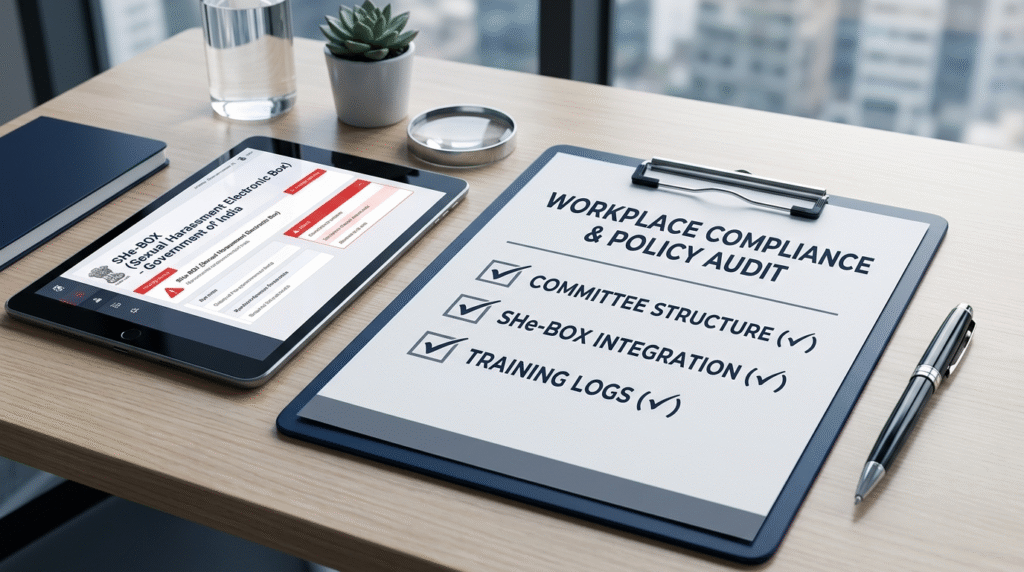
Gap 2: The SHe-Box and Portal Disconnect
The second major gap involves how companies handle the central government’s online portal, known as the SHe-Box (Sexual Harassment Electronic Box). Many business leaders treat this portal as an outside public tool that has nothing to do with their internal company tracking systems.
The latest NCW update changes this view entirely. The new audit rules explicitly state that updating and using the SHe-Box portal is a mandatory requirement. It is a core parameter that inspectors check during an annual compliance audit.
The risk here is very real. If an employee feels uncomfortable using internal corporate channels, they can log a complaint directly on the national government portal. If your company does not have a clear, active workflow to monitor and respond to portal alerts, you will show a major tracking delay to the authorities. This lag signals to inspectors that your internal response system is broken.
Gap 3: Missing Proof for Training and Sensitization
The third gap is the complete absence of verifiable training records. Many human resource departments assume that showing a general onboarding video to new hires or holding a quick company-wide meeting counts as proper legal safety training.
The new audit framework completely rejects this shortcut. To pass a state review, an organization must present formal logs, attendance lists, and date-stamped records showing two completely separate tracks of training:
- General Employees: Regular, documented awareness programs that teach the entire workforce about personal boundaries and reporting rights.
- Committee Members: Deep, specialized capacity-building workshops that train internal committee members on how to legally gather evidence and run fair inquiries.
If a state inspector reviews your business and you cannot produce clear, written proof of who attended these sessions and what they were taught, the law treats it as an un-sensitized workplace. A lack of data serves as primary proof that you are out of compliance.
What's Next?
The latest NCW advisory makes one thing clear: government inspectors are no longer just checking if your company has a workplace safety policy. They are actively auditing how well your systems work in real life. Passive compliance has become a major legal risk for business leaders.
To stay ahead of these regulatory changes, you need to review your current processes, audit your regional branch offices, and secure your documentation now.
You can read the official government directive directly by reviewing the notification. To help you spot and fix more hidden gaps in your organization immediately, download our step-by-step checklist today to protect your workplace and ensure you are ready for your next annual audit.
Read the full notification here: https://cdn.ncw.gov.in/wp-content/uploads/2026/06/211KB.pdf
Download our FREE simplified checklist